
While Germany has been named as the second-best place for remote working in Europe, German companies are still slow to adapt to flexible work models. Research shows, that only about 40% of companies allowed employees to work from home in 2019. This number includes both fully and partially remote workers. Some sources even claim that Germans prefer to work from an office. So what is the state of remote work in Germany? We have interviewed the companies the companies leading the remote work movement in Germany to learn from their experience.
Interview with Maria Fazikova, Recruiter at komoot
Komoot makes it easier for you to experience authentic outdoor adventures. Whether road cycling, hiking, bikepacking or mountain biking, komoot’s superior planning and navigation technology allows you to easily discover more of the great outdoors.
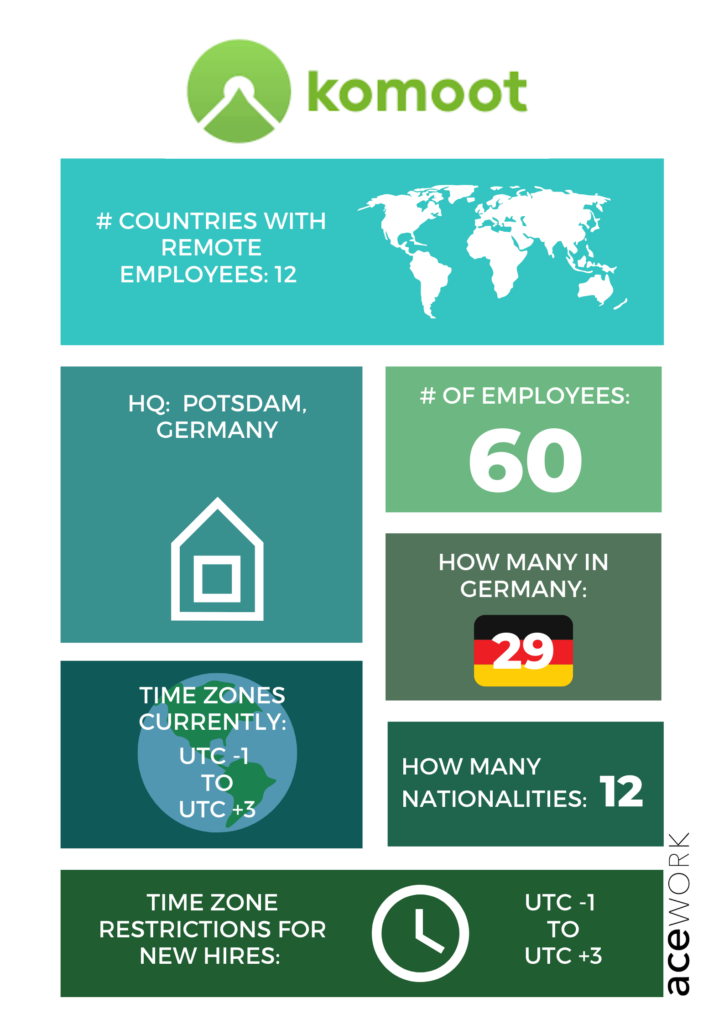
- – HQ: Potsdam, Germany
- – # of employees: 60
- – # Countries of remote employees: 12
- – How many in Germany: 29
- – How many nationalities: 21
- – Time zones currently: UTC-1 to UTC+3
- – Time zone restrictions for new hires: UTC-1 to UTC+ 3
How distributed is the team at komoot? Would you consider yourselves “remote-first”, and if yes, what does that mean for you?
Yes, we are a fully remote team and currently have 60 people in 12 countries. Remote first means for us that the whole team is remote.
How would you describe your remote work culture? What are your core values, and how are they expressed in your culture?

Everyone at komoot works towards one goal – to deliver the best possible product for our customers and change the way people explore. We pay huge amounts of attention to our hiring because to us working with smart, like-minded people is crucial for such a successful company as komoot. Komoot hires the best folks, to do what they love. That means selecting inspiring people who are experts in what they do, and who you will therefore actually want to go on a hike or grab a beer with.
Our Values:
- – Impact
- – Responsibility
- – Communication
- – Curiosity
- – Excellence
For details of our values please check out the komoot manifesto.
What influenced komoot’s decision to become a distributed team?
Becoming remote we have gained an incredible competitive advantage and access to talent from almost everywhere, not just one place. We can now hire the best people that are on the market.
Please share some of the challenges you have encountered along the way. How did you overcome them?

The main challenge is actually to maintain the great culture we have; I believe a typical problem startups/scaleups with rapid growth have. We have gatherings 3 times/year when the whole team meets to spend some quality time together. As a company we encourage 100 % honest feedback at all times and provide our employees with the necessary support needed to thrive in a remote environment etc.
What does your hiring process look like? Has it changed from when you didn’t consider remote candidates?
It has not changed that much from when we were not remote, however, the processes and workflow have been adapted to suit the remote. A short overview of the steps is:
- – Screening by recruiter and hiring manager
- – Challenge / real world practical task
- – 1st Interview with one of your potential future teammates and your future mentor
- – 2nd Interview another one of your potential future teammates and a peer from another team that you would closely work with
- – Offer stage
- –> View the full details on the hiring process here.
The foundation for successful remote work lies in clear structures, processes, and systems for a.) collaboration, b.) communication and c.) documentation.
Can you explain what each of those looks like at komoot?

This could be an essay apart to describe all of the above in detail but to sum it up we have implemented management tools, apps and processes which make remote work and collaboration possible. We use tools like Trello, Slack Miro, Zoom etc. to stay on top of every project and stay informed. There are Monday Morning meetings -when the whole company meet to kick off the week, whilst teams have their own catch-ups. Zoom meetings are a regular thing but we try not to overuse them and often communicate in writing (through the above mentioned tools). We have a contact core time when everyone is available so you can easily reach out to colleagues if necessary.
What “perks & benefits” do offer your employees?
- – The team – the best benefit we have
- – 38 days paid holidays
- – gatherings in awesome locations 3 times/year
- – We cover the cost of the co-working centres or home – office setup for our employees
- – Latest technology and tools
- – Working on an awesome product used by millions of people
Interested to work at komoot? Prove that you are ‘remote ready’ and apply directly through acework. Sign up here to start your application process.